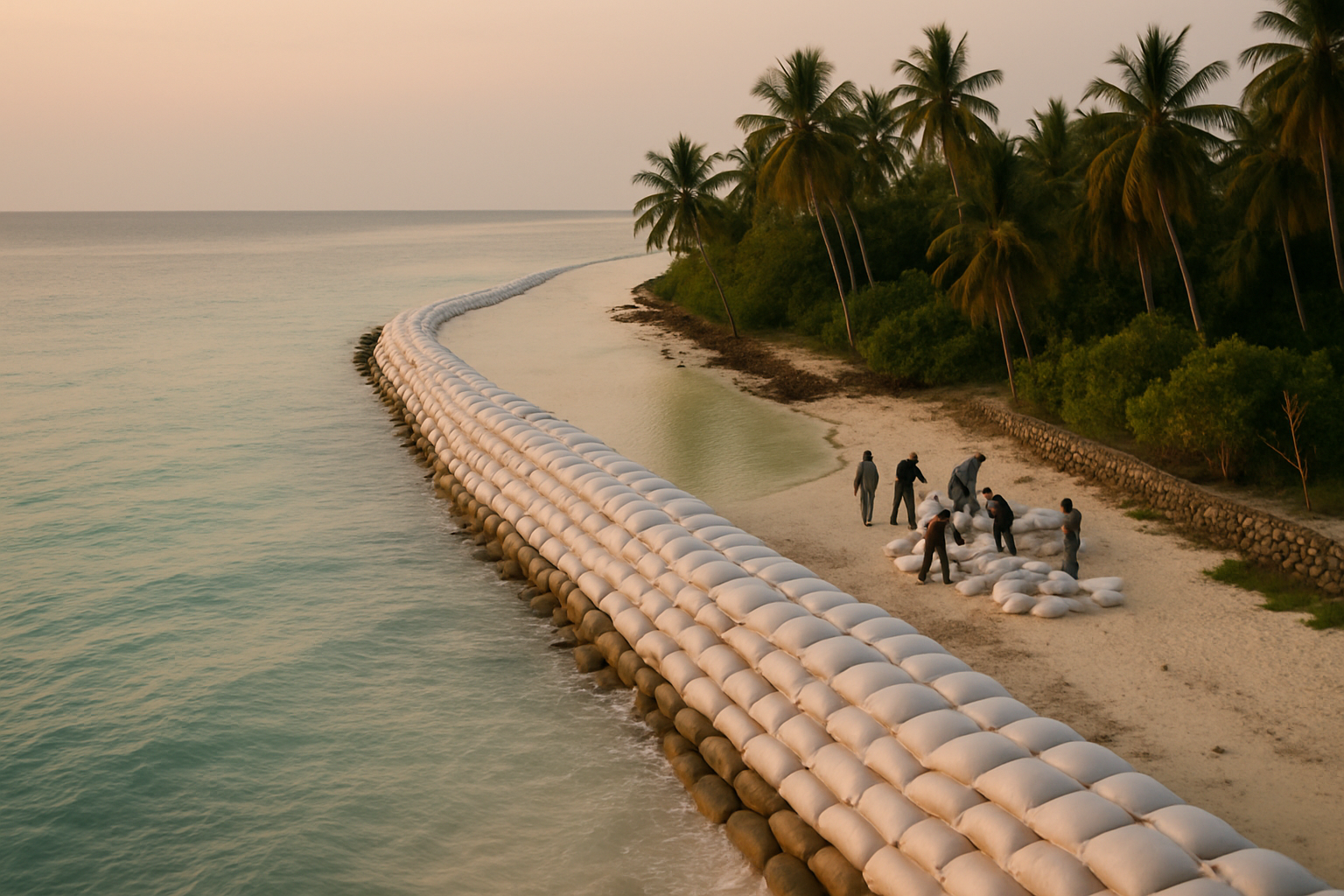
Kolamaafushi was not supposed to be on the list. In a 2021 Climate Ministry assessment, the island — a wide green crescent in northern Gaafu Alif — was ranked “low vulnerability.” Four years later, at the spring equinox tide, seawater crossed the road outside the school and pooled against the breadfruit trees for the first time anyone could remember.
Across the six southern atolls Masnooee visited between October and March, the story repeats with unnerving consistency. Councils that were told they had time, that were placed behind other islands in the queue for engineered defences, have begun to build their own. The materials are whatever can be put on a supply boat: bagged beach sand, crushed coral rubble, geotextile sheeting bought from a hardware store in Male’, and on Fuvahmulah, an old fishing dhoni filled with cement and sunk offshore to blunt the swell.
A ministry that cannot keep up
The Climate Ministry’s Coastal Adaptation Fund, established in 2023 with a Rf 2.1 billion commitment drawn from bilateral grants and the sovereign Blue Bond issuance, was meant to be the central instrument of the country’s shoreline defence. Three years in, a Masnooee analysis of disbursement records — obtained under a right-to-information request filed in December — finds that only 18% of the fund has reached the atolls.
Of the 36 projects listed as “active” in the ministry’s internal dashboard, 11 had not received their first tranche at the time of our review. Four had been re-scoped so many times that the original engineers had walked away.
In interviews across three atolls, council presidents described a procurement process built for resorts, not for communities. Tender documents run to 60 pages; the pre-qualification stage demands references from engineering firms that, on most inhabited islands, simply do not exist.
Where the adaptation fund has gone
The math of a metre
The IPCC’s sixth assessment places the Indian Ocean regional sea-level rise at 3.7 millimetres per year. On a country whose mean natural elevation is 1.5 metres, that is not an abstraction. It is a line creeping up the veranda steps of a house in Fuvahmulah built the year a grandmother was born.
But the more urgent variable is not the trend — it is the storm surge piggy-backing on it. The monsoon intensification predicted in the 2024 MET Maldives downscaling study appears to have arrived early. Three of the five highest single-day rainfall readings on Maldivian record have been logged since 2023.
What the councils want
The asks are smaller than you might expect. In a Masnooee survey of 84 island council presidents, nearly three-quarters ranked simplified grant access above new funding as their top adaptation priority. Second came a shared engineering bench — a pool of coastal engineers contracted by the ministry and deployable to any atoll, rather than each council tendering separately.
Neither is an expensive idea. Neither has moved past cabinet working-group status since it was proposed in 2024.
The morning we left Kolamaafushi, the tide turned at 05:14. A boy of about nine was helping his grandfather count the bags that had slipped in the night. Forty-two had gone. They would be back at four the next morning to replace them. Down the road, outside the council office, the scheduled government engineer was two years, three months and eleven days late.